
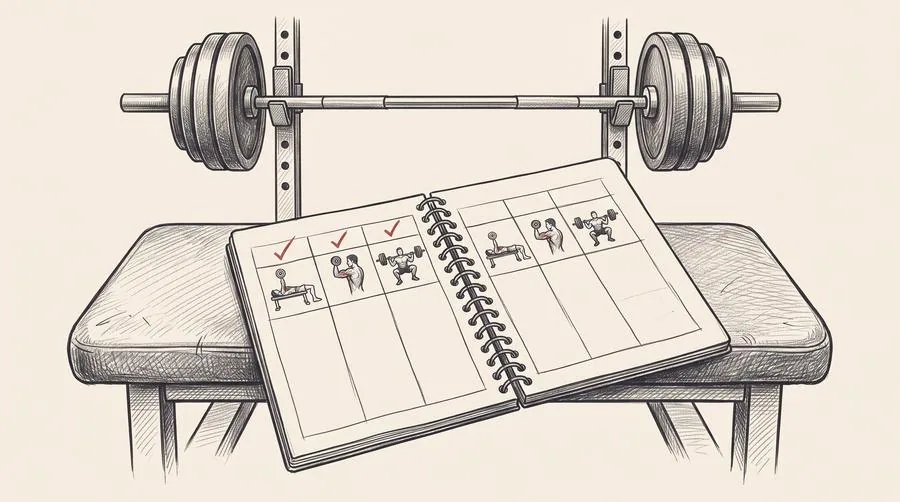
The Arnold split is a six-day bodybuilding routine built on three workouts: chest and back, shoulders and arms, and legs. You run all three, then run them again, and rest on the seventh day. Every major muscle gets trained twice a week, with a lot of total volume.
It takes its name from Arnold Schwarzenegger, who won Mr. Olympia seven times (1970 to 1975, and 1980). Most modern versions trace back to The New Encyclopedia of Modern Bodybuilding (1985, revised 1998), which he wrote with Bill Dobbins. Exact sets and exercises differ from source to source, so treat any "official" Arnold split you see online, including this one, as a faithful version of the structure rather than a copy of his personal log.
The weekly schedule
| Day | Workout |
|---|---|
| Monday | Chest & Back |
| Tuesday | Shoulders & Arms |
| Wednesday | Legs |
| Thursday | Chest & Back |
| Friday | Shoulders & Arms |
| Saturday | Legs |
| Sunday | Rest |
Abs get a few sets at the end of most sessions.
What makes it different
Chest and back on the same day. Most splits put chest with shoulders and triceps (push) and back with biceps (pull). The Arnold split pairs the two biggest muscles of the upper body, which work in opposite directions. That pairing makes supersets easy: a set of presses, then straight into a set of rows or pull-ups. Arnold was known for exactly this, and the idea holds up. Studies on paired agonist and antagonist sets found that lifters got the same or more work done in less time compared with straight sets (Robbins et al., 2010; Paz et al., 2017).
Arms get their own day. Shoulders, biceps and triceps share a session, so arms are trained fresh instead of after chest or back has tired them out.
Each muscle twice a week. A 2016 meta-analysis found that training a muscle at least twice a week produced more growth than once a week (Schoenfeld, Ogborn and Krieger, 2016). The Arnold split builds that in by design.
High volume. Six sessions with several exercises each adds up quickly. Research points to a dose-response relationship between weekly sets and muscle growth, with 10 or more hard sets per muscle per week outperforming lower volumes (Schoenfeld et al., 2017). The Arnold split clears that bar for every muscle, which is both its strength and its cost: it asks a lot from your recovery.
A sample Arnold split routine
Use a weight you could lift for two more reps than the target on the first set. Rest 90 seconds to 2 minutes on big lifts and about 60 seconds on smaller ones.
Chest & Back (Monday and Thursday)
| Exercise | Sets x reps |
|---|---|
| Barbell bench press | 4 x 8 to 10 |
| Pull-up (add weight once 12 is easy) | 4 x as many as you can |
| Incline dumbbell press | 3 x 10 |
| Barbell row | 4 x 8 to 10 |
| Dumbbell pullover | 3 x 12 |
| Hanging leg raise | 3 x 12 to 15 |
On Monday only, you can add 3 sets of 5 deadlifts after rows. Many versions put the deadlift on back day so it doesn't eat into your squats.
Shoulders & Arms (Tuesday and Friday)
| Exercise | Sets x reps |
|---|---|
| Overhead barbell press | 4 x 8 |
| Dumbbell lateral raise | 3 x 12 |
| Rear delt fly | 3 x 12 |
| Barbell curl | 3 x 10 |
| Close-grip bench press | 3 x 10 |
| Incline dumbbell curl | 3 x 10 |
| Overhead triceps extension | 3 x 12 |
| Crunch | 3 x 15 |
Legs (Wednesday and Saturday)
| Exercise | Sets x reps |
|---|---|
| Back squat | 4 x 8 |
| Walking lunge or leg press | 3 x 10 |
| Romanian deadlift | 3 x 10 |
| Leg curl | 3 x 12 |
| Standing calf raise | 4 x 12 to 15 |
| Hanging leg raise | 3 x 12 to 15 |
Bench taken? Swap a lift for one that hits the same muscle in the same way: dumbbell press for barbell press, chest-supported row for barbell row, hack squat for back squat.
How to progress on the Arnold split
The routine only works if the weights climb. The simplest method is double progression:
- Pick a rep range, for example 8 to 10.
- Stay at the same weight until you hit the top of the range on every set.
- Next session, add the smallest jump you can: usually 5 lb (2.5 kg) for upper body lifts and 10 lb (5 kg) for squats and deadlifts.
- If you stall for several sessions in a row, drop the weight by about 10% and build back up.
Write everything down. On a six-day plan it's impossible to remember what you lifted on Tuesday's lateral raises two weeks ago.
Who the Arnold split is for
The Arnold split suits lifters who:
- can train six days a week and want to,
- already know the main lifts and can do them with good form,
- sleep, eat and recover well enough to handle the volume,
- care most about building muscle, especially in the upper body.
It's a lot for a true beginner. If you're new, start with fewer exercises and sets, or read our guide to the Arnold split for beginners. If six days won't fit your week, see 4- and 5-day versions of the Arnold split.
Thinking about push/pull/legs instead? Here's the full Arnold split vs PPL comparison.
Tips that make it work
- Superset chest and back once you're used to the volume. It shortens the longest session of the week. See the chest and back superset workout.
- Keep Sunday as a full rest day. Six days on is the whole point; seven is too many.
- Run it for 8 to 12 weeks before judging it. Muscle takes time.
- Take a lighter week every 6 to 8 weeks or whenever everything feels heavy.
- Eat enough protein, roughly 0.7 to 1 g per pound of bodyweight a day, and enough total food to recover.
Run the Arnold split without a spreadsheet
Arnold Split is a free iPhone app that plans this program for you. It looks like a paper training log: open it, see today's page with every set and rep, and lift.
- It sets your starting weights based on how long you've been lifting.
- Hit every rep and the weight goes up next session. Miss three sessions in a row and it backs off 10%.
- Plates per side show under every barbell lift, and warm-up sets are worked out for you.
- Swap any exercise for a built-in alternative.
- New lifters start on Junior Arnold, a lighter version with six lifts a day. Finish one cycle to unlock The Golden Era: supersets, daily abs and new B days.
Sources
- Schoenfeld BJ, Ogborn D, Krieger JW. Effects of resistance training frequency on measures of muscle hypertrophy. Sports Medicine, 2016.
- Schoenfeld BJ, Ogborn D, Krieger JW. Dose-response relationship between weekly resistance training volume and increases in muscle mass. Journal of Sports Sciences, 2017.
- Robbins DW, Young WB, Behm DG. The effect of an upper-body agonist-antagonist resistance training protocol on volume load and efficiency. Journal of Strength and Conditioning Research, 2010.
- Paz GA, Robbins DW, de Oliveira CG, Bottaro M, Miranda H. Volume load and neuromuscular fatigue during an acute bout of agonist-antagonist paired-set vs. traditional-set training. Journal of Strength and Conditioning Research, 2017.
- Schwarzenegger A, Dobbins B. The New Encyclopedia of Modern Bodybuilding. Simon & Schuster, 1985, revised 1998.
Arnold Split is not affiliated with or endorsed by Arnold Schwarzenegger.