
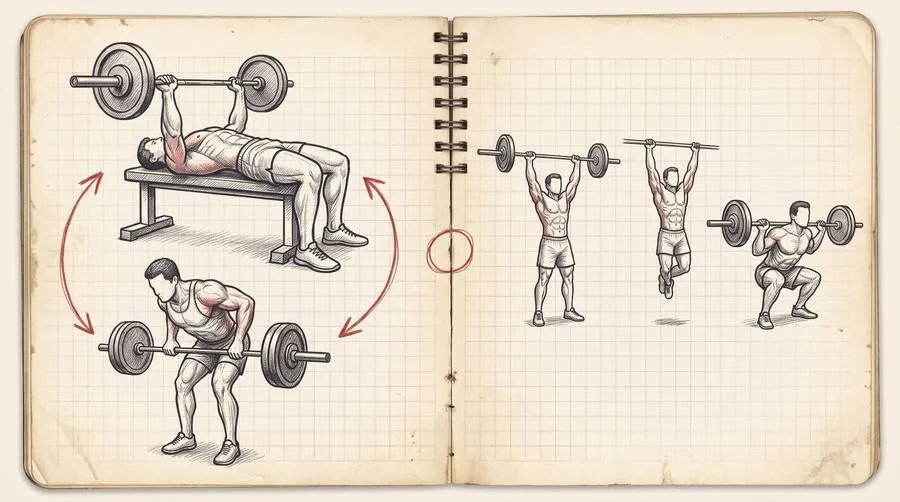
Both splits train six days a week and hit every muscle twice. The difference is how they group the upper body.
- Arnold split: chest & back, shoulders & arms, legs.
- Push/pull/legs (PPL): push (chest, shoulders, triceps), pull (back, biceps), legs.
That one change affects session length, arm volume, how you superset and how sore you'll be. Here's how they compare.
Side by side
| Arnold split | Push/pull/legs | |
|---|---|---|
| Day 1 | Chest & back | Push: chest, shoulders, triceps |
| Day 2 | Shoulders & arms | Pull: back, biceps |
| Day 3 | Legs | Legs |
| Days per week | 6 (each workout twice) | 6 (each workout twice), or 3 |
| How muscles are grouped | Opposing muscles together | Muscles that move the same way together |
| Easiest superset | Press + row (chest + back) | Biceps + triceps on different days, so fewer natural pairs |
| Arm training | Fresh, on their own day | After chest or back has tired them |
| Hardest session | Chest & back | Push or legs |
How the Arnold split works
The Arnold split pairs muscles that do opposite jobs. Chest pushes, back pulls, so you can alternate them in supersets: bench press, then rows; incline press, then pull-ups. Paired sets like this let you get the same or more work done in less time than straight sets (Robbins et al., 2010; Paz et al., 2017).
Shoulders and arms get a day to themselves. Your biceps and triceps start that session fresh instead of being half-spent from rows or presses. That's a big reason the Arnold split has a reputation for building arms.
The catch: chest and back together is a long, demanding session, and shoulders and triceps get hit on two days in a row. They work during chest presses on day one, then train directly on day two.
How PPL works
PPL groups muscles by movement. Push day covers anything that presses away from you, pull day anything that pulls toward you. Because related muscles train together, they get a full recovery window before the next session that uses them.
The catch: arms are always trained last and tired. Triceps come after a lot of pressing, biceps after a lot of rows and pull-ups. Some lifters find their arms lag on PPL unless they add extra arm sets.
What the research says
There's no study that pits the Arnold split directly against PPL. What we do know applies to both:
- Frequency: training a muscle at least twice a week beats once a week for growth (Schoenfeld, Ogborn and Krieger, 2016). Both splits do this when you run them six days a week.
- Volume: more weekly sets per muscle, up to a point, means more growth, with 10 or more sets per week outperforming fewer (Schoenfeld et al., 2017). Both splits can hit that easily.
So for muscle growth, the split matters less than the basics: enough hard sets, adding weight over time, and recovering between sessions. Pick the one you'll actually stick with.
Which one should you pick?
Choose the Arnold split if:
- you want bigger arms and shoulders and like training them fresh,
- you enjoy supersets and want to spend less of each session resting,
- you like the old-school feel of training like the Golden Era,
- your shoulders handle a pressing day followed by a shoulder day.
Choose PPL if:
- you have cranky shoulders or elbows and want more recovery between pressing sessions,
- you prefer simple, movement-based days,
- you might drop to three days a week (PPL works well once through),
- you care more about strength on the big lifts than arm size.
Still not sure? Run one for 8 to 12 weeks, track your lifts, then try the other. Your logbook will tell you more than any article.
Can you combine them?
Yes. A popular hybrid runs PPL for the first half of the week and the Arnold split for the second half: push, pull, legs, then chest & back, shoulders & arms, legs. It spreads the stress around and keeps training interesting. The trade-off is more exercise variety to track.
Related guides
- The Arnold split: complete 6-day workout plan
- The Arnold split for beginners
- 4- and 5-day versions of the Arnold split
Run the Arnold split without the guesswork
Arnold Split is a free iPhone app that plans every set, rep and weight of the Arnold split. It looks like a paper training log, raises the weight when you've earned it, shows plates per side for every barbell lift, and lets you swap any exercise for a built-in alternative.
Sources
- Schoenfeld BJ, Ogborn D, Krieger JW. Effects of resistance training frequency on measures of muscle hypertrophy. Sports Medicine, 2016.
- Schoenfeld BJ, Ogborn D, Krieger JW. Dose-response relationship between weekly resistance training volume and increases in muscle mass. Journal of Sports Sciences, 2017.
- Robbins DW, Young WB, Behm DG. The effect of an upper-body agonist-antagonist resistance training protocol on volume load and efficiency. Journal of Strength and Conditioning Research, 2010.
- Paz GA, Robbins DW, de Oliveira CG, Bottaro M, Miranda H. Volume load and neuromuscular fatigue during an acute bout of agonist-antagonist paired-set vs. traditional-set training. Journal of Strength and Conditioning Research, 2017.
Arnold Split is not affiliated with or endorsed by Arnold Schwarzenegger.